


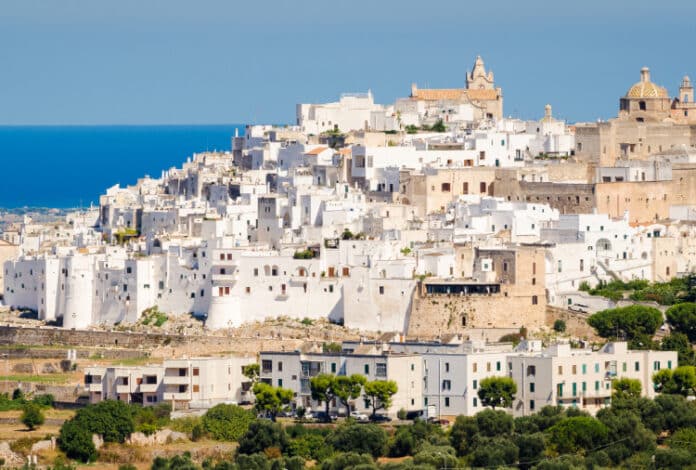
Known as “the White City”, Ostuni stands on three hills in the land of Salento. Located on the south-eastern slopes of the Murgia, Ostuni is famous for its historic center characterized by whitewashed buildings and houses.
The custom of using lime for buildings is very old and it seems that it arose not only because it was an easily available product and gave more light to the city streets but also because in the Middle Ages it was thought to be a natural disinfectant against the plague.
The city has very ancient origins that seem to date back to the Paleolithic but the first city nucleus was founded, around the 7th century BC, by the Messapians. After the Roman domination Ostuni was occupied by Ostrogoths, Longobards, Saracens and Byzantines. Between the 11th and 12th centuries the Normans conquered the Apulian territory and founded the county of Puglia which then passed into the hands of the Swabians. With the Angevins and the Aragonese, the city opened up to trade and saw the construction of the Port of Villanova, on the ruins of the ancient Petrolla.
The city has managed to preserve the medieval conformation which sees the construction of numerous leaning buildings and the presence of multi-storey houses which were thus built both for defensive needs and to make full use of the space available within the walls.
Only after the Second World War did the city begin to develop tourism both in the hinterland and along the seafront with the construction of accommodation facilities and services.
In addition to tourism, the town lives on agriculture thanks to the cultivation of olive trees and vines and the presence of various farms. Due to its peculiar characteristics Ostuni is a destination that welcomes tourists in every season of the year not only from all over Italy but also from abroad.

ITALIANO
Conosciuta come “la Città bianca”, Ostuni sorge su tre colline nella terra del Salento. Situata alle pendici sud-orientali della Murgia, Ostuni è famosa per il suo centro storico caratterizzato da edifici e casette di calce bianca.
L’usanza di utilizzare la calce per le costruzioni è molto antica e sembra che derivasse non solo perché questa era un prodotto di facile reperibilità e dava maggiore luce alle vie cittadine ma anche perché nel Medioevo si pensava fosse un disinfettante naturale contro la peste.
La città ha origini davvero antiche che sembrano risalire al paleolitico ma il primo nucleo cittadino fu fondato, attorno VII secolo a.C., dai Messapi. Dopo la dominazione romana Ostuni fu occupata da Ostrogoti, Longobardi, Saraceni e Bizantini. Fra l’XI e il XII secolo i Normanni conquistarono il territorio pugliese e fondarono la contea di Puglia che poi passò nelle mani degli Svevi. Con gli angioini e gli aragonesi la città si aprì al commercio e vide la costruzione del Porto di Villanova, sulle macerie dell’antica Petrolla.
La città è riuscita a conservare la conformazione medioevale che vede la costruzione di numerosi edifici addossati e la presenza di case a più piani che erano così costruite sia per esigenze difensive sia per fruttare appieno lo spazio disponibile all’interno delle mura.
Solo nel secondo dopoguerra la città ha iniziato a svilupparsi turisticamente sia nella zona dell’entroterra che nel lungomare con la costruzione di strutture ricettive e di servizi.
Oltre che di turismo il paese vive di agricoltura grazie alle coltivazioni di olivi e viti e alla presenza di diverse masserie. Per le sue peculiari caratteristiche Ostuni è una meta che accoglie turisti in ogni stagione dell’anno non solo da tutta l’Italia ma anche dall’estero.